MAE
0.199122
QuantLab Research
A controlled comparison of finite-difference methods, PINNs and DeepONets for American option pricing, evaluated on accuracy, computational cost and repeated-query efficiency.
Experiment 01
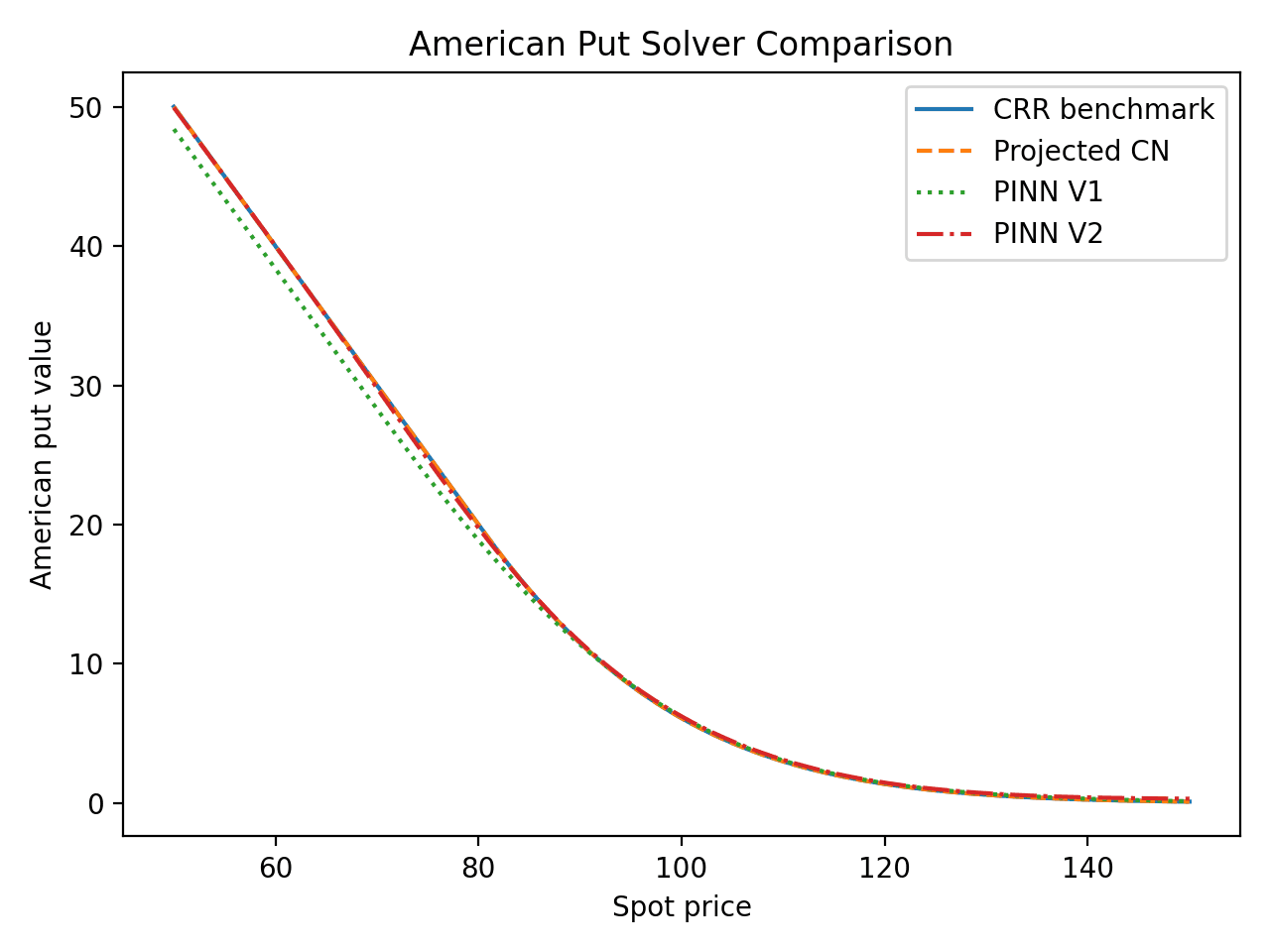
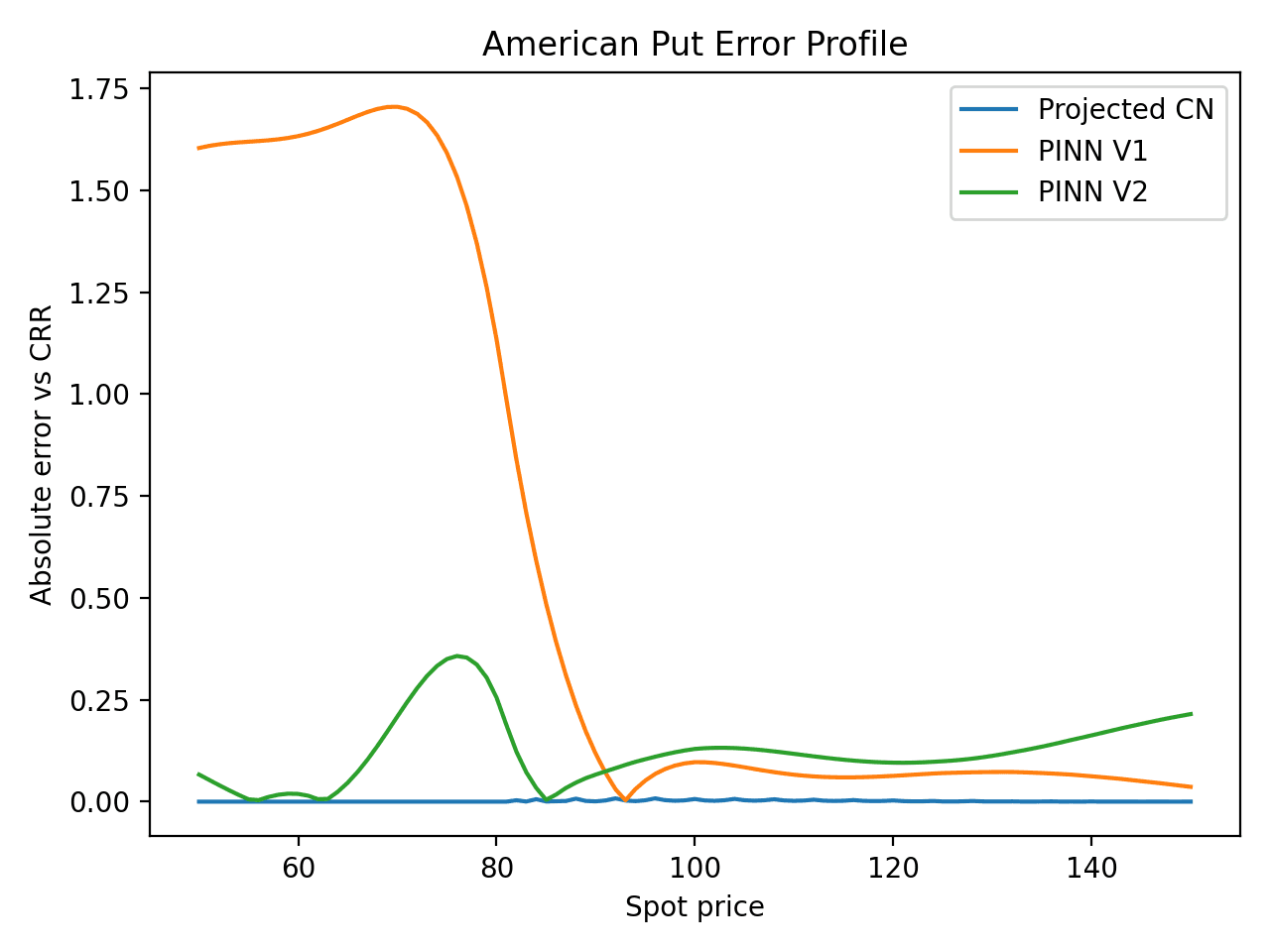
CRR provides the reference solution. Projected Crank–Nicolson is compared with two PINN formulations across a common spot-price grid.
| Method | MAE | RMSE | Max error | ATM error | Training / solve | Inference |
|---|---|---|---|---|---|---|
CRR benchmark | 0.000000 | 0.000000 | 0.000000 | 0.000000 | 59.252751 s | — |
Projected Crank–Nicolson | 0.001386 | 0.002399 | 0.008078 | 0.006499 | 0.051331 s | — |
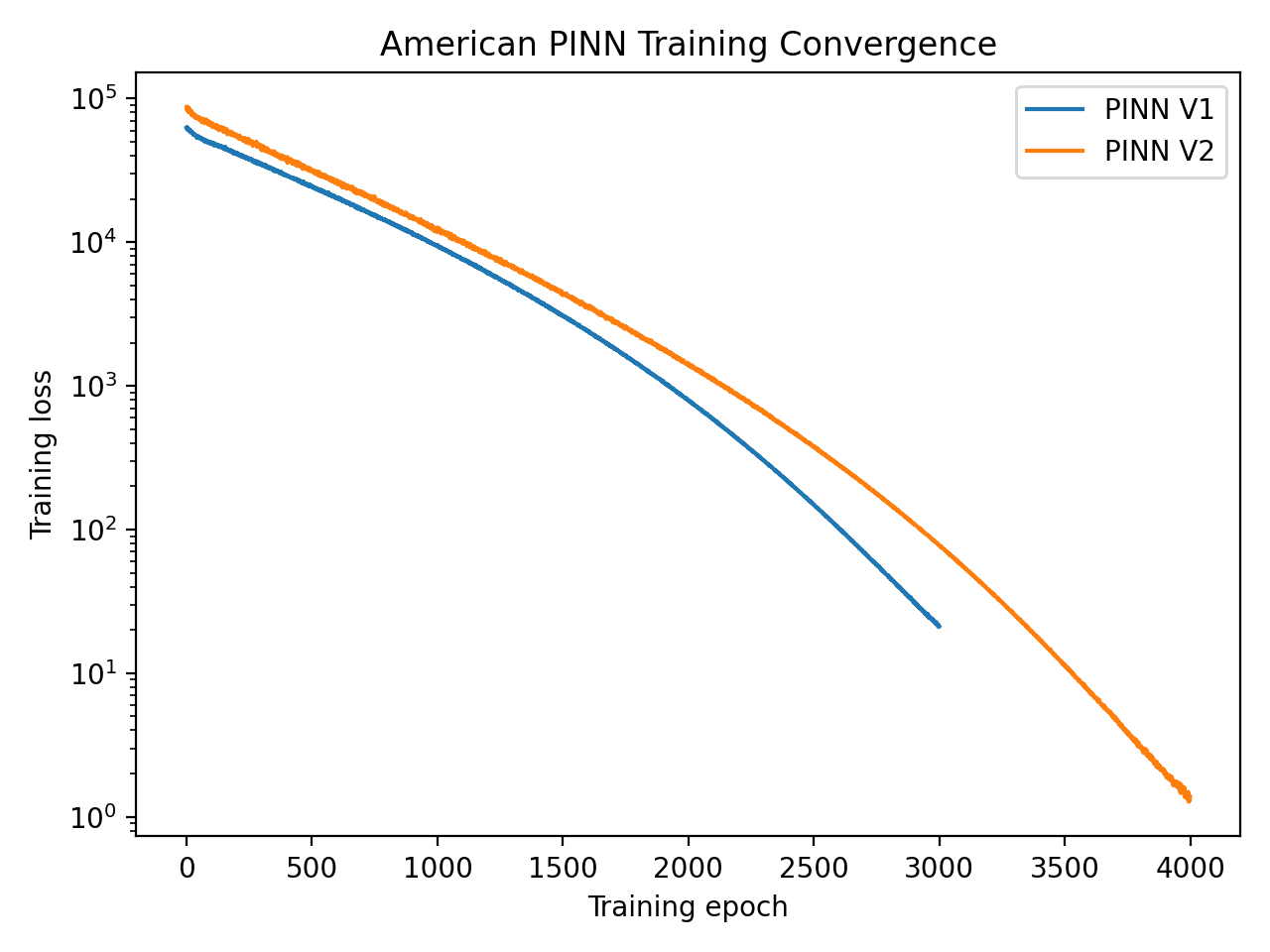
PINN V1 obstacle_penalty | 0.577899 | 0.907986 | 1.704741 | 0.096848 | 24.408700 s | 0.005155 s |
PINN V2 fischer_burmeister | 0.124013 | 0.148751 | 0.357380 | 0.129387 | 44.907313 s | 0.005575 s |
Experiment 02
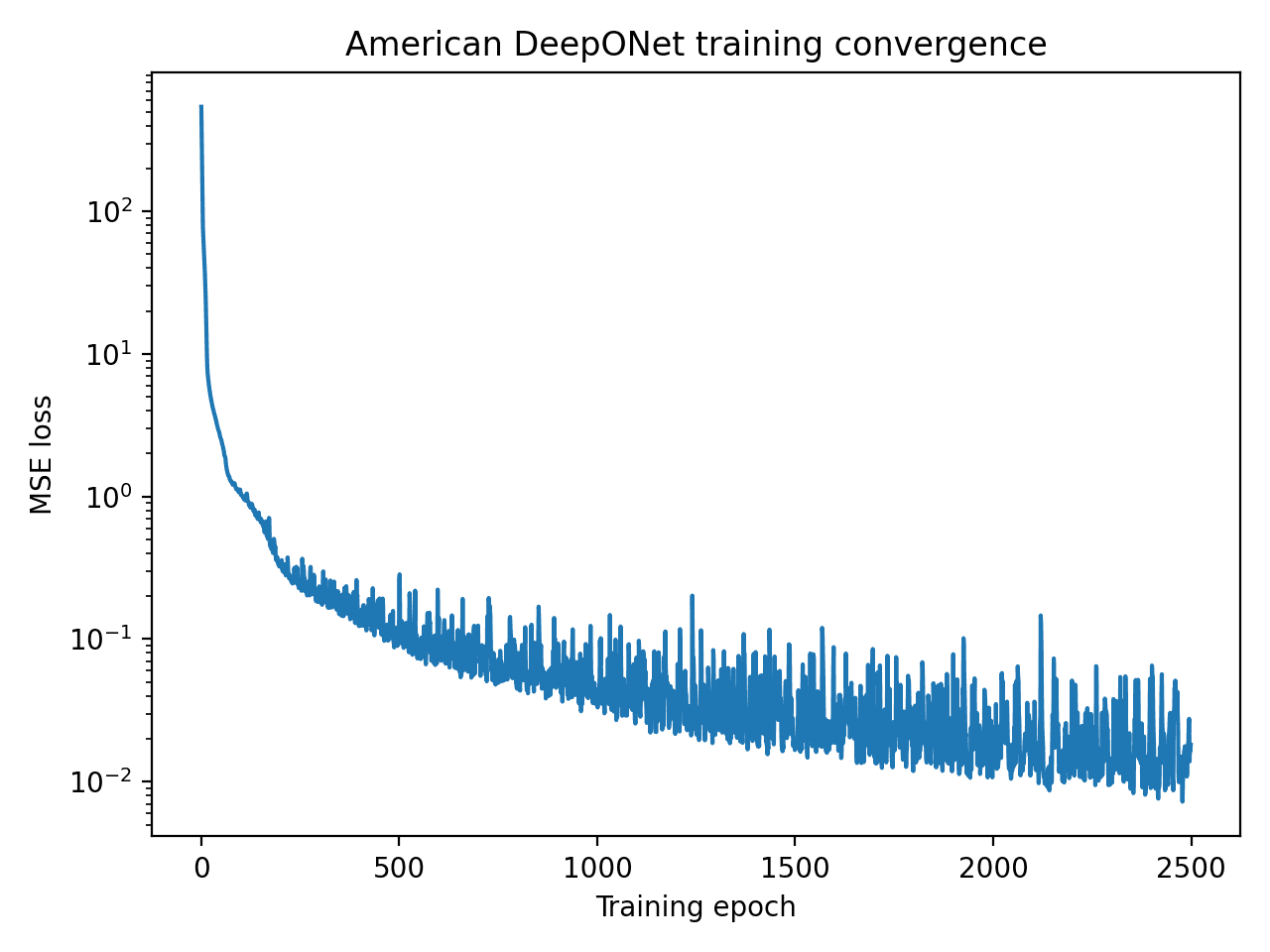
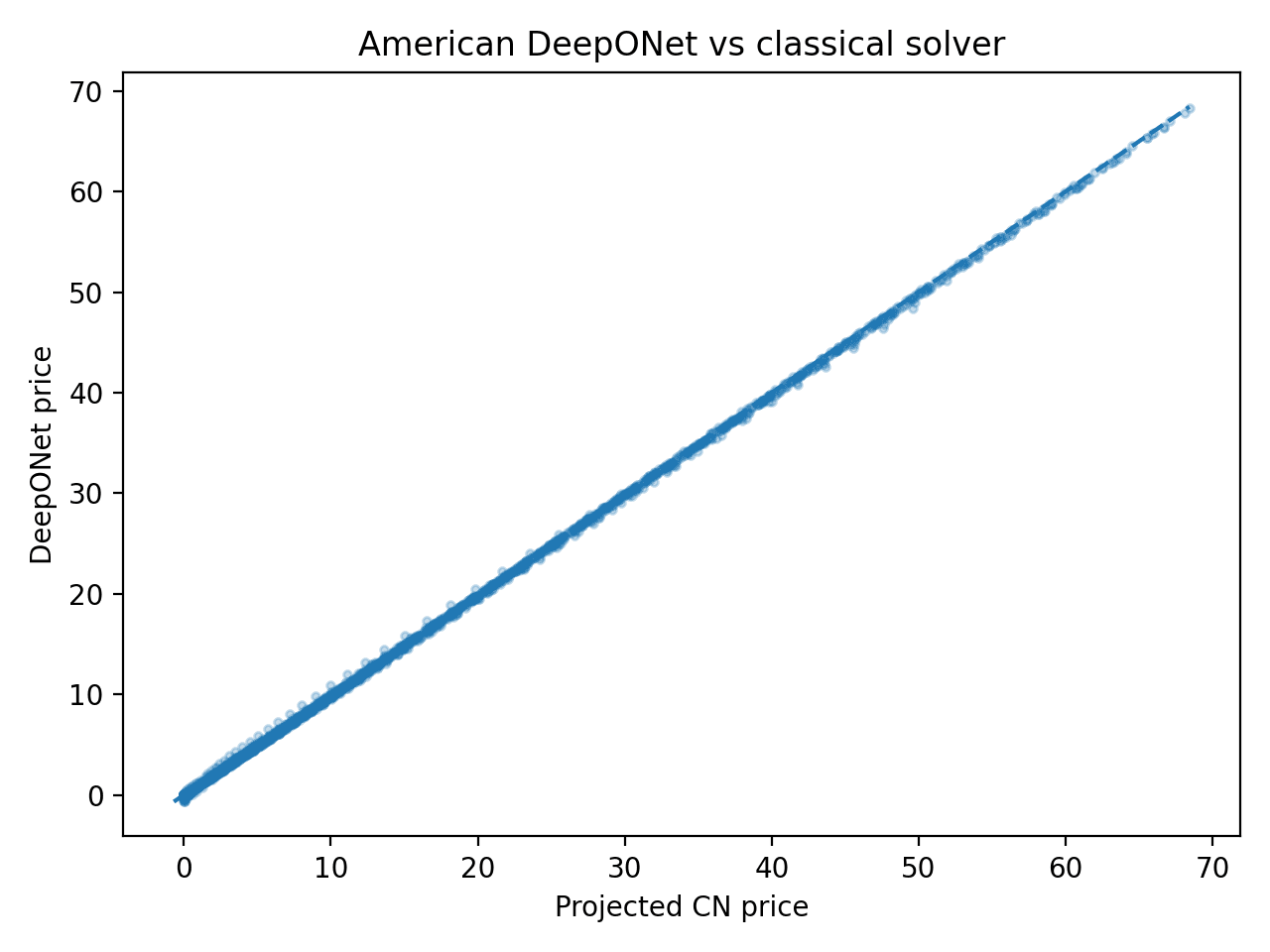
DeepONet learns the mapping from option parameters and evaluation coordinates to American put values generated by the classical solver.
MAE
0.199122
RMSE
0.259732
Median error
0.161657
95% error
0.538324
Max error
1.232681
Branch operator
Trunk operator
Experiment 03
DeepONet has an expensive offline stage but very cheap online inference. This experiment measures the point at which repeated pricing queries recover that upfront cost.
Projected CN
1.545e-2
seconds / query
DeepONet
6.735e-7
seconds / query
Measured online speedup
22933.34×
Break-even
2,053
approximate pricing queries required before the offline data-generation and training cost is recovered.
Data generation
3.04 s
Training
28.66 s
Total offline cost
31.70 s
Interpretation
The scientific-ML methods are evaluated not simply on whether they reproduce an option price, but on whether their additional training cost is justified by generalisation and repeated-query performance. This makes the comparison fundamentally about computational regimes rather than declaring one method universally superior.